In the ever-expanding world of social media, some videos capture attention not just because they are funny, dramatic, or unusual, but because they spark debate about human behavior.
Etiquette, and the small annoyances that can escalate into absurd situations. One such video, recently going viral on TikTok, has amassed over 97 million views and counting.
Showing a bizarre confrontation between two airplane passengers — all stemming from a single strand of long hair. The video, initially shared by an account dedicated to “airplane encounters,” quickly captured the fascination of viewers around the world.
What might seem like a minor annoyance — hair draped over a seatback — escalated into a scene that left both passengers and observers bewildered, confused, and entertained.
The Incident: How Hair Became a Battlefield
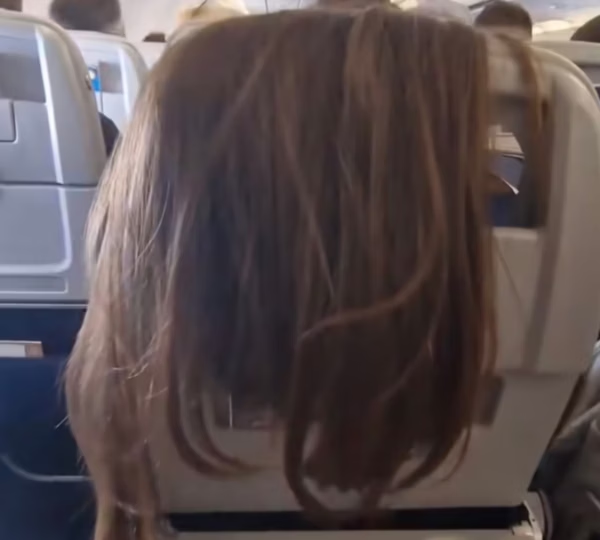
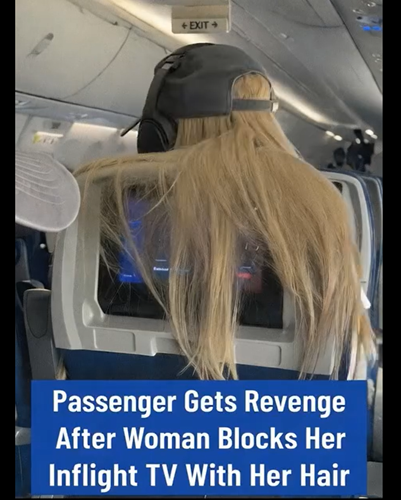
The clip opens with a close-up of a front-row passenger, a woman with long, flowing hair, completely oblivious to the inconvenience she is causing the passenger directly behind her.
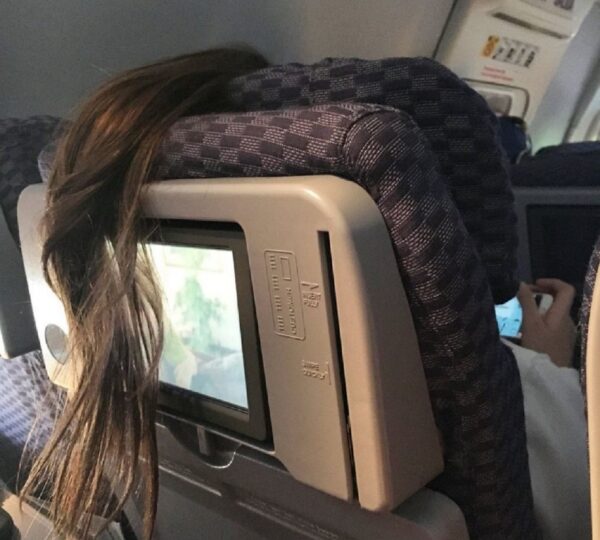
Her hair spills over the back of her seat, completely blocking the rear passenger’s view of the in-flight entertainment screen.
At first, the woman behind simply flips the hair back over the seat, a small, polite gesture aimed at restoring her own comfort without confrontation.
However, the front-row passenger repeatedly tosses her hair forward again, as if oblivious to or dismissive of the subtle protest.
Each flick of hair becomes a tiny act of defiance, escalating tension in the cramped, shared space of an airplane cabin, where personal space is notoriously limited.
The situation could have ended there — a minor inconvenience, resolved with patience or a polite request — but the rear passenger escalates the scenario in an entirely unexpected and shocking way.
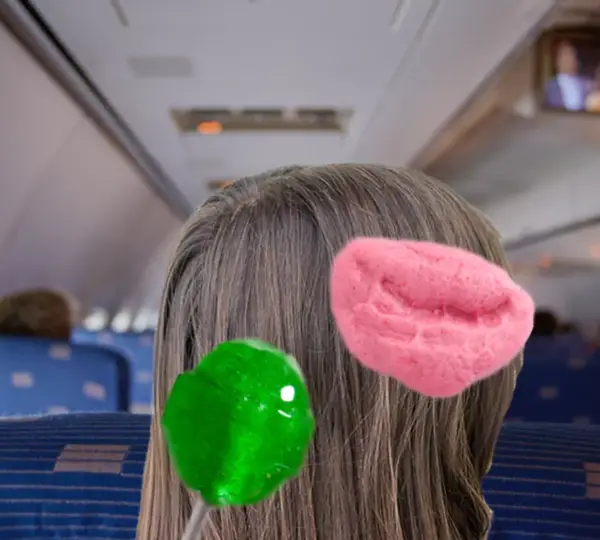
The video shows her snipping small pieces of hair, sticking a lollipop into it, and even dipping the hair into her cup of coffee.
Throughout this, the front-row passenger appears completely unaware, continuing to flick her hair forward casually.
This combination of minor irritations, personal space invasions, and over-the-top retaliation created a scenario that viewers couldn’t look away from.
In just a few seconds, a simple issue — hair over a seat — became an online spectacle, sparking debates about etiquette, civility, and social norms.
The Flight Attendant’s Role: A Missed Intervention?
Interestingly, the video also captures a flight attendant walking by during the incident. The attendant doesn’t intervene, and it’s unclear whether they noticed the full extent of the unfolding drama.
For some viewers, this raised questions about airline staff responsibilities. Should cabin crew step in when passengers engage in disruptive behavior, even if the conflict seems minor?
Many commenters expressed frustration at the perceived inaction. “How is this allowed to go on in a confined space?” one user asked. Another noted, “Flight attendants should step in before it escalates — this is a recipe for chaos.”
Others argued that airline staff are trained to handle safety and operational concerns, not minor passenger disputes.
“It’s not their job to referee hair battles,” wrote one TikTok user. “Unless someone is actually endangering another passenger, it’s on the individuals involved.”
Regardless, the presence of the flight attendant adds another layer of surrealism to the video. A small act of retaliation — lollipop in hair, coffee dunking, repeated flicks — occurs in full view of both the staff and other passengers, yet no intervention occurs.
This contributed to the viral appeal, as viewers couldn’t help but imagine themselves in that claustrophobic, tension-filled cabin.
Online Reactions: Divided Opinions
Once the video went live, it spread like wildfire across TikTok, Instagram, and other social platforms. Comments poured in from viewers expressing a wide range of reactions — amusement, disgust, disbelief, and empathy.
Some sided with the rear passenger, believing that she had been pushed to her limit by the front-row passenger’s inconsiderate behavior.
“At first I was on the side of the woman in front,” wrote one user. “But after she kept throwing her hair back over the seat, she deserved whatever came next. I would’ve done the same.”

Others questioned the authenticity of the incident. “There’s no way someone would just let this happen without noticing,” one person commented.
“You would absolutely know someone is touching your hair. It’s a wig. Totally staged.”
Some theorized that the passengers might actually know each other. Observant viewers noted that both women were wearing similar hats, suggesting they could have been acquaintances or friends engaging in a staged prank for online content.
This theory only fueled further debate, with commenters taking sides in a virtual courtroom, analyzing every flick of hair, each lollipop dip, and the subtle expressions of the front-row passenger.
Then there were those who weighed in from a more philosophical perspective, pondering etiquette, personal boundaries, and the psychology of passive-aggressive behavior.
“This isn’t about hair,” wrote one commenter. “It’s about respect, boundaries, and how people respond when they feel powerless.
It’s fascinating and terrifying at the same time.”
Etiquette in the Sky: When Does Retaliation Cross the Line?
The video sparked broader conversations about airplane etiquette, a topic that has long captivated the public.
Air travel is uniquely challenging because it forces strangers into close quarters for extended periods. Personal space is limited, and small annoyances can escalate quickly.
Social media users debated the ethics of the rear passenger’s response. Was snipping hair, adding candy, and dunking strands into coffee justified? Or was it excessive and inappropriate?
“Honestly,” wrote one user, “I understand the frustration. But dipping someone’s hair into coffee? That’s crossing a line.”
Others disagreed: “She asked politely multiple times. You keep flicking hair over someone’s seat? You deserve a little payback.”
Psychologists and behavioral experts, quoted in subsequent news coverage, suggested that such extreme reactions often emerge when individuals feel trapped in a situation they cannot control.
In a confined airplane cabin, minor irritations can feel magnified, and for some, retaliatory actions become a way to reclaim a sense of autonomy.
Staging or Reality? The Skepticism Factor
Despite the widespread amusement and fascination, skepticism ran high. Many viewers pointed out inconsistencies in the video — the timing of the hair flicks, the calm demeanor of the front passenger despite obvious provocations, and the exaggerated reactions of the rear passenger.
Some argued that the video might be a staged prank, a performance designed to maximize views and engagement.
TikTok is notorious for producing viral content where ordinary situations are exaggerated for entertainment value.
“I don’t buy it for a second,” one commenter wrote. “No one would let someone play with their hair like that without flipping out immediately. It’s definitely staged.”
Whether real or performed, the video succeeded in capturing the attention of millions.
The discussion itself — about boundaries, etiquette, and civility — became part of the entertainment, with the original hair dispute serving as a springboard for larger conversations.
Lessons About Human Behavior and Public Spaces
Beyond humor and outrage, the video offers insight into human behavior, particularly in shared public spaces. Small annoyances — whether hair, phone use, or seat reclining — can trigger disproportionate reactions.
Social norms dictate patience, politeness, and tolerance, yet human nature often veers toward self-interest and immediate gratification.
The incident also demonstrates how anonymity and the social environment affect behavior. In the airplane cabin, passengers may act differently than they would in private, knowing that social norms and authority figures are nearby.
Similarly, posting such incidents online allows for public judgment, creating a feedback loop that amplifies social responses and moral outrage.
The viral TikTok illustrates these dynamics in a small, highly relatable scenario.
Millions of viewers could imagine themselves in the shoes of either passenger, sparking debates that extend far beyond the cabin itself.
The Impact of Virality
The video’s virality also highlights the power of social media to turn ordinary events into global phenomena.
With 97 million views and counting, it shows how attention can rapidly amplify even the most mundane conflicts.
News outlets picked up the story, interviewing etiquette experts, psychologists, and even flight attendants to analyze the dynamics.
Hashtags like #AirplaneEtiquette, #Hairgate, and #TikTokDrama trended on multiple platforms, further cementing the video as a cultural touchpoint.
For many viewers, the incident provided both entertainment and a chance to reflect on social behavior.
Others saw it as a cautionary tale about escalating minor annoyances into dramatic confrontations.
Conclusion: A Hairy Situation with Lessons for All
Whether staged or genuine, the airplane hair dispute on TikTok sparked conversation, laughter, and debate.
It reminds us that in shared spaces, personal boundaries matter, and small irritations can escalate quickly.
It also illustrates the human need for control, dignity, and a sense of fairness, even in seemingly trivial situations.
For millions of viewers, the clip was more than just a funny video — it was a mirror reflecting their own frustrations, insecurities, and social interactions.
It challenged assumptions, provoked outrage, and created shared experiences around a simple, universal theme: how we treat one another when we are close together in confined spaces.
Airline etiquette, personal boundaries, and conflict management have never been more entertaining to watch than in this bizarre, viral, hair-raising scenario.
And while the world debates whether the lollipop, coffee, and snipped hair were justified, one thing is certain: this video will be remembered as one of the most outrageous airplane moments in recent social media history.
In the ever-expanding world of social media, some videos capture attention not just because they are funny, dramatic, or unusual, but because they spark debate about human behavior.
Etiquette, and the small annoyances that can escalate into absurd situations. One such video, recently going viral on TikTok, has amassed over 97 million views and counting.
Showing a bizarre confrontation between two airplane passengers — all stemming from a single strand of long hair. The video, initially shared by an account dedicated to “airplane encounters,” quickly captured the fascination of viewers around the world.
What might seem like a minor annoyance — hair draped over a seatback — escalated into a scene that left both passengers and observers bewildered, confused, and entertained.
The Incident: How Hair Became a Battlefield
The clip opens with a close-up of a front-row passenger, a woman with long, flowing hair, completely oblivious to the inconvenience she is causing the passenger directly behind her.
Her hair spills over the back of her seat, completely blocking the rear passenger’s view of the in-flight entertainment screen.
At first, the woman behind simply flips the hair back over the seat, a small, polite gesture aimed at restoring her own comfort without confrontation.
However, the front-row passenger repeatedly tosses her hair forward again, as if oblivious to or dismissive of the subtle protest.
Each flick of hair becomes a tiny act of defiance, escalating tension in the cramped, shared space of an airplane cabin, where personal space is notoriously limited.
The situation could have ended there — a minor inconvenience, resolved with patience or a polite request — but the rear passenger escalates the scenario in an entirely unexpected and shocking way.
The video shows her snipping small pieces of hair, sticking a lollipop into it, and even dipping the hair into her cup of coffee.
Throughout this, the front-row passenger appears completely unaware, continuing to flick her hair forward casually.
This combination of minor irritations, personal space invasions, and over-the-top retaliation created a scenario that viewers couldn’t look away from.
In just a few seconds, a simple issue — hair over a seat — became an online spectacle, sparking debates about etiquette, civility, and social norms.
The Flight Attendant’s Role: A Missed Intervention?
Interestingly, the video also captures a flight attendant walking by during the incident. The attendant doesn’t intervene, and it’s unclear whether they noticed the full extent of the unfolding drama.
For some viewers, this raised questions about airline staff responsibilities. Should cabin crew step in when passengers engage in disruptive behavior, even if the conflict seems minor?
Many commenters expressed frustration at the perceived inaction. “How is this allowed to go on in a confined space?” one user asked. Another noted, “Flight attendants should step in before it escalates — this is a recipe for chaos.”
Others argued that airline staff are trained to handle safety and operational concerns, not minor passenger disputes.
“It’s not their job to referee hair battles,” wrote one TikTok user. “Unless someone is actually endangering another passenger, it’s on the individuals involved.”
Regardless, the presence of the flight attendant adds another layer of surrealism to the video. A small act of retaliation — lollipop in hair, coffee dunking, repeated flicks — occurs in full view of both the staff and other passengers, yet no intervention occurs.
This contributed to the viral appeal, as viewers couldn’t help but imagine themselves in that claustrophobic, tension-filled cabin.
Online Reactions: Divided Opinions
Once the video went live, it spread like wildfire across TikTok, Instagram, and other social platforms. Comments poured in from viewers expressing a wide range of reactions — amusement, disgust, disbelief, and empathy.
Some sided with the rear passenger, believing that she had been pushed to her limit by the front-row passenger’s inconsiderate behavior.
“At first I was on the side of the woman in front,” wrote one user. “But after she kept throwing her hair back over the seat, she deserved whatever came next. I would’ve done the same.”
Others questioned the authenticity of the incident. “There’s no way someone would just let this happen without noticing,” one person commented.
“You would absolutely know someone is touching your hair. It’s a wig. Totally staged.”
Some theorized that the passengers might actually know each other. Observant viewers noted that both women were wearing similar hats, suggesting they could have been acquaintances or friends engaging in a staged prank for online content.
This theory only fueled further debate, with commenters taking sides in a virtual courtroom, analyzing every flick of hair, each lollipop dip, and the subtle expressions of the front-row passenger.
Then there were those who weighed in from a more philosophical perspective, pondering etiquette, personal boundaries, and the psychology of passive-aggressive behavior.
“This isn’t about hair,” wrote one commenter. “It’s about respect, boundaries, and how people respond when they feel powerless.
It’s fascinating and terrifying at the same time.”
Etiquette in the Sky: When Does Retaliation Cross the Line?
The video sparked broader conversations about airplane etiquette, a topic that has long captivated the public.
Air travel is uniquely challenging because it forces strangers into close quarters for extended periods. Personal space is limited, and small annoyances can escalate quickly.
Social media users debated the ethics of the rear passenger’s response. Was snipping hair, adding candy, and dunking strands into coffee justified? Or was it excessive and inappropriate?
“Honestly,” wrote one user, “I understand the frustration. But dipping someone’s hair into coffee? That’s crossing a line.”
Others disagreed: “She asked politely multiple times. You keep flicking hair over someone’s seat? You deserve a little payback.”
Psychologists and behavioral experts, quoted in subsequent news coverage, suggested that such extreme reactions often emerge when individuals feel trapped in a situation they cannot control.
In a confined airplane cabin, minor irritations can feel magnified, and for some, retaliatory actions become a way to reclaim a sense of autonomy.
Staging or Reality? The Skepticism Factor
Despite the widespread amusement and fascination, skepticism ran high. Many viewers pointed out inconsistencies in the video — the timing of the hair flicks, the calm demeanor of the front passenger despite obvious provocations, and the exaggerated reactions of the rear passenger.
Some argued that the video might be a staged prank, a performance designed to maximize views and engagement.
TikTok is notorious for producing viral content where ordinary situations are exaggerated for entertainment value.
“I don’t buy it for a second,” one commenter wrote. “No one would let someone play with their hair like that without flipping out immediately. It’s definitely staged.”
Whether real or performed, the video succeeded in capturing the attention of millions.
The discussion itself — about boundaries, etiquette, and civility — became part of the entertainment, with the original hair dispute serving as a springboard for larger conversations.
Lessons About Human Behavior and Public Spaces
Beyond humor and outrage, the video offers insight into human behavior, particularly in shared public spaces. Small annoyances — whether hair, phone use, or seat reclining — can trigger disproportionate reactions.
Social norms dictate patience, politeness, and tolerance, yet human nature often veers toward self-interest and immediate gratification.
The incident also demonstrates how anonymity and the social environment affect behavior. In the airplane cabin, passengers may act differently than they would in private, knowing that social norms and authority figures are nearby.
Similarly, posting such incidents online allows for public judgment, creating a feedback loop that amplifies social responses and moral outrage.
The viral TikTok illustrates these dynamics in a small, highly relatable scenario.
Millions of viewers could imagine themselves in the shoes of either passenger, sparking debates that extend far beyond the cabin itself.
The Impact of Virality
The video’s virality also highlights the power of social media to turn ordinary events into global phenomena.
With 97 million views and counting, it shows how attention can rapidly amplify even the most mundane conflicts.
News outlets picked up the story, interviewing etiquette experts, psychologists, and even flight attendants to analyze the dynamics.
Hashtags like #AirplaneEtiquette, #Hairgate, and #TikTokDrama trended on multiple platforms, further cementing the video as a cultural touchpoint.
For many viewers, the incident provided both entertainment and a chance to reflect on social behavior.
Others saw it as a cautionary tale about escalating minor annoyances into dramatic confrontations.
Conclusion: A Hairy Situation with Lessons for All
Whether staged or genuine, the airplane hair dispute on TikTok sparked conversation, laughter, and debate.
It reminds us that in shared spaces, personal boundaries matter, and small irritations can escalate quickly.
It also illustrates the human need for control, dignity, and a sense of fairness, even in seemingly trivial situations.
For millions of viewers, the clip was more than just a funny video — it was a mirror reflecting their own frustrations, insecurities, and social interactions.
It challenged assumptions, provoked outrage, and created shared experiences around a simple, universal theme: how we treat one another when we are close together in confined spaces.
Airline etiquette, personal boundaries, and conflict management have never been more entertaining to watch than in this bizarre, viral, hair-raising scenario.
And while the world debates whether the lollipop, coffee, and snipped hair were justified, one thing is certain: this video will be remembered as one of the most outrageous airplane moments in recent social media history.