The winter morning was a wall of white silence as I cracked open my front door. The air, biting and sharp, hit my lungs with the force of a physical blow. “Of course,” I sighed, watching the fresh layer of powder settle over the remnants of yesterday’s storm. I grabbed my shovel from the porch railing and stepped out. Upstairs, my son Micah was still lost in the deep, rhythmic sleep of childhood, his white noise machine humming a distant lullaby.
I worked with a mechanical efficiency, counting my strokes like I counted tips at the diner. As a single mother, I had learned that everything in life was a transaction of labor against time. When I finished my own walkway, I leaned on the shovel, my breath curling in the air like silver smoke. Three houses down, the porch light at Lois’s house flickered. I watched the door open just a few inches—long enough for a cane to poke through, followed by the frantic, snowy blur of Benny, her tiny white terrier. Benny barked once, a sharp protest against the cold, before retreating inside. The snowbank at their door was simply too high for a woman of Lois’s age to conquer.
I didn’t think about it; I just moved. I dragged my shovel through the drifts to her property and began to clear a path. I didn’t knock, and I didn’t ask for permission. I just dug. Over the next week, it became my secret ritual. I’d clear my world, then hers, and return home to the smell of coffee and shortbread. Lois never offered a grand speech of gratitude, but sometimes I’d catch her silhouette behind the lace curtains, a small, dignified nod acknowledging our silent pact.
One morning, the routine shifted. Sitting on my own doorstep was a heavy thermos wrapped in a checkered kitchen towel. When I uncapped it, the steam carried the rich, comforting scent of cloves and cinnamon. It was a potent, spiced tea—a liquid thank-you that warmed my hands long before it reached my throat. Micah, watching from the kitchen table with a blue crayon gripped in his fist, asked if the “dog lady” had sent it.
“She did, honey,” I told him. “It’s a gift for the snow stuff.”
Inspired, Micah spent the morning hunched over his paper. He presented me with a masterpiece: a drawing of Benny, Lois waving from her porch, and a massive blue snow angel with wings that seemed to span the entire neighborhood. He had drawn me in a bright green dress, standing tall with my shovel. I tucked his art into her mailbox the next day, feeling a rare sense of community in our isolated, frozen world.
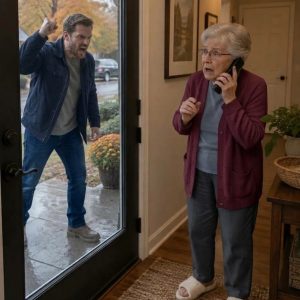
But two days later, the warmth of that connection was shattered. I returned from a shift to find a piece of paper curled on my doorstep, stiff with frost. The message was written in jagged, angry block letters: “NEVER COME AGAIN OR YOU’LL REGRET IT!! LOIS.”
The words felt like a slap. I stood there, trembling not from the cold, but from a sudden, visceral confusion. It made no sense. I went inside and immediately pulled up my doorbell camera footage. I needed to see the moment Lois had turned on me. But as I scrolled back to 5:14 a.m., I didn’t see an elderly woman with a cane. I saw a younger woman in a sharp brown coat. She stepped onto my porch with a calculated, predatory stride, dropped the note, and vanished.
I walked past Lois’s house that afternoon. The curtains were drawn tight, and the silence from within was absolute. No Benny barking, no flickering television. On the third day of this eerie quiet, I spotted a man in the yard messing with the porch light. I approached him, my heart hammering against my ribs. He introduced himself as Paul, Lois’s great-nephew, and explained with a strained, practiced smile that he and his sister, Alexa, had moved in to help their aunt “transition.”
“She needs her family right now, Dako,” he said, his tone dripping with a condescending kind of politeness. “And you’re not family.” I caught a glimpse of Alexa watching from the window—the woman from the camera. The “transition” they spoke of felt less like care and more like a foreclosure.
A week passed. The snow continued to fall, but I stayed away, paralyzed by the threatening note and the hostile energy radiating from the house. Eventually, a moving truck appeared, and then a “For Sale” sign. A young couple, Daniel and Leah, moved in shortly after. When I brought them banana bread, I asked about the previous owner. Leah looked saddened. “The nephew said she had a bad fall and had to go into a high-support care home. It sounded like it happened very fast.”
I spent that night scouring the internet, searching for any trace of Lois in local facility directories. I felt like a failure; I had let the snow cover the tracks of a woman who had become my silent friend. It wasn’t until twelve days later that a blue envelope arrived in the mail, addressed in a thin, deliberate cursive I recognized from the small labels she used to put on her spice jars.
The letter was a revelation and a heartbreak. Paul and Alexa had indeed swooped in, isolating her and rushing the sale of her home to claim the proceeds. “They told me not to write,” Lois wrote. “They don’t act like family, but I remember what’s real. I remember the sound of your shovel and the drawing Micah made. I kept it in my nightstand.”
She told me that they had taken her house, but she had managed to save what mattered most. Benny had been dropped at the local shelter because the care home didn’t allow pets, and she had instructed the staff that I would be the one to come for him. Most shockingly, she had established a small trust for Micah. “Enough to remind him that kindness is worth something,” the letter read. “Tell him I miss the snow angels.”
I didn’t wait. I took Micah to the shelter that afternoon. When we walked past the cages, a familiar, frantic yip broke through the noise. Benny didn’t just wag his tail; his entire body wiggled with a desperate, joyful recognition. Micah scooped him up, and for the first time in weeks, the cold felt manageable.
A week later, we found the care home listed at the bottom of the letter. We walked into Room 302 with a basket of muffins and a bouquet of sunflowers. Lois was sitting by the window, her face pale but her eyes bright. When Benny trotted into the room and rested his head on her lap, she let out a breath she seemed to have been holding for a lifetime.
“You came,” she whispered, her hand trembling as she touched Micah’s cheek.
“I told you,” I said, kneeling by her chair. “I don’t just do it when it’s easy.”
Lois smiled, a genuine, radiant expression that defied the sterile walls of the facility. She told me she didn’t want lawyers or a fight with her nephews; she had found peace in knowing Benny was safe and that Micah would have a head start in life. We stayed for an hour, the dog never leaving her side. As we walked back to the car through a fresh flurry of snow, Micah held my hand on one side and Benny’s leash on the other. I looked back at the window and saw her waving. The note on my door had tried to use her name to threaten me, but the woman herself had used her heart to save us. In the end, the snow didn’t bury our bond; it simply revealed who was truly willing to dig for it.