I was leaving on a business trip when the airline announced the cancellation.
Weather. Mechanical issue. No clear answers. Annoyed but relieved, I took a cab home, thinking I’d surprise my husband, Ethan. We hadn’t had much time together lately. A quiet night sounded perfect.
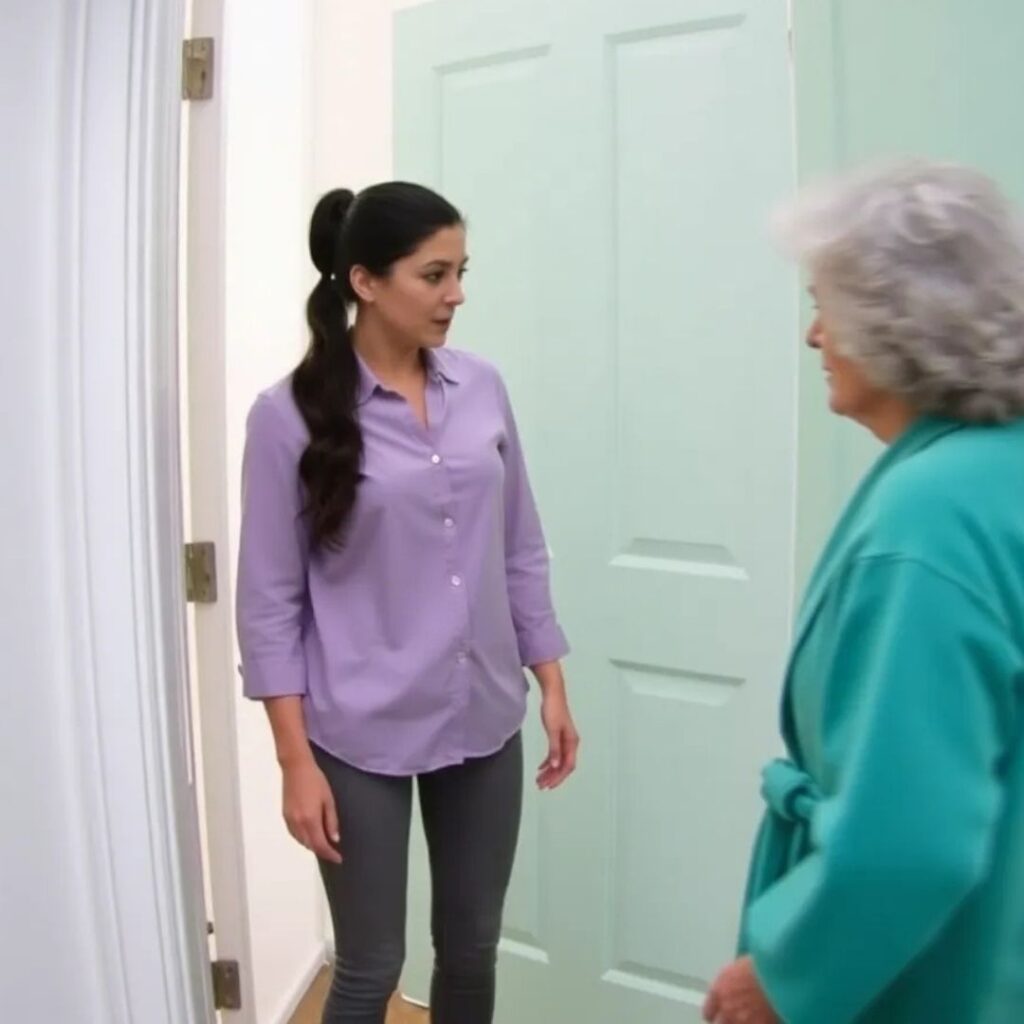
I unlocked the door.
A woman stood in the hallway wearing my robe.
She looked relaxed, hair damp, holding a mug from our kitchen. She smiled politely, like I was the one intruding.
“Oh,” she said. “You must be the realtor, right? My husband said you’d come to evaluate our apartment.”
My stomach dropped, but my face didn’t move.
“Yes,” I heard myself say. “That’s me.”
She stepped aside without suspicion. “Great. He’s in the shower. Feel free to look around.”
I walked in slowly, my heart hammering so hard I worried she’d hear it. Everything looked… lived in. Shoes by the couch that weren’t mine. A second toothbrush in the holder. Fresh flowers on the table—flowers Ethan had never once bought for me.
“Nice place,” I said, forcing a professional tone.
“Thank you,” she replied warmly. “We just moved in together a few months ago.”
Together.
I nodded, pretending to inspect the living room while my mind raced. If I confronted her now, she’d scream. If I called Ethan out, he’d lie. I needed to know how far this went.
“So,” I asked casually, “how long have you two been married?”
She laughed. “Married? No, but we’re engaged. The ring’s being resized.”
The hallway spun.
She led me toward the bedroom, chatting about renovation plans. On the dresser sat a framed photo—Ethan and her at the beach. Dated last summer. That was when he’d told me he was on a work retreat.
The bathroom door opened. Steam poured out.
Ethan’s voice followed. “Babe, did you—”
He stopped when he saw me.
For a split second, his face emptied of color. Then it filled with calculation.
“Oh,” he said quickly. “You’re early.”
The woman turned to him, confused. “Honey? You know the realtor?”
I closed my folder slowly and smiled.
“Yes,” I said. “We know each other very well.”
Ethan opened his mouth to speak.
And that’s when I decided not to let him.
I took control of the room before Ethan could.
“Why don’t you finish getting dressed,” I said to him calmly. “This will take a few minutes.”
He hesitated, then nodded, clearly hoping I’d leave before things got worse. He disappeared back into the bathroom.
The woman—Lily, she introduced herself—looked embarrassed. “I’m sorry, this is awkward.”
“No need,” I said gently. “These things happen when paperwork overlaps.”
She relaxed. That told me something important: she had no idea.
I asked her questions the way a realtor would. Lease terms. Utilities. Plans for selling. Each answer tightened the knot in my chest.
Ethan had put our apartment on the market—my apartment, bought before we married—without my knowledge. He’d forged my signature on preliminary documents. Lily showed me the email thread on her phone, proud of how “transparent” Ethan had been.
When Ethan returned, dressed and pale, I closed my folder.
“I’ve seen enough,” I said. “I’ll be in touch.”
At the door, I turned to Lily. “One more thing. Can you check the deed? Just to confirm the owner’s name.”
Ethan snapped, “That’s not necessary.”
Lily frowned. “Why not?”
“Because,” I said softly, “it’s only in my name.”
Silence.

Lily’s face changed as understanding set in. “What?”
I handed her my business card—the real one, from my actual job in corporate compliance. “I’m not a realtor,” I said. “I’m his wife.”
Ethan lunged for me. Lily stepped back, stunned.
“You lied to me,” Lily whispered to him.
He tried to explain. He always did.
I left before he could say another word.
Within days, my lawyer froze the sale. The forged documents became evidence. Lily sent me everything—emails, messages, recordings of Ethan promising her a future he didn’t own.
She left him the same week.
Ethan begged. Then threatened. Then went quiet.
The aftermath wasn’t dramatic. It was administrative. That’s how real endings happen—through filings, signatures, and silence.
Ethan lost access to the apartment. Then his job, when the fraud reached his employer. He tried to paint himself as a victim of misunderstanding. The documents told a cleaner story.
Lily and I met once, weeks later. Coffee. Neutral ground. No anger left between us—only clarity.
“I thought I was special,” she said.
“So did I,” I replied.
That realization hurt less when shared.
I changed the locks. Changed my routines. Learned how quickly certainty can evaporate—and how powerful calm can be when chaos expects tears.
If you’re reading this, remember: you don’t owe honesty to someone who built their life on lies. You owe it to yourself.
So ask yourself:
If your plans changed tomorrow, what truth might you walk back into?
Would you confront it—or study it until it revealed everything?
And if silence gave you leverage, would you use it wisely?
Share your thoughts in the comments. Stories like this matter because awareness often arrives disguised as inconvenience.
If this resonated, pass it on. Someone else might be unlocking a door tonight, about to learn that staying quiet for one moment can change the entire ending.
The legal proceedings moved with the cold, rhythmic precision of a ticking clock. But while the apartment was safe and the locks were changed, the “administrative ending” was only the first layer of the collapse. Ethan hadn’t just been trying to sell a piece of real estate; he had been treating our entire life as a liquid asset.
Part 2: The Paper Trail of a Ghost
A month after the locks were changed, I found a small, locked metal box hidden behind the insulation in the guest closet. I didn’t call a locksmith. I used a hammer.
Inside weren’t love letters or photos of Lily. They were credit card statements, loan applications, and a second passport. Ethan hadn’t just been living a double life; he had been preparing for a third.
As I dug through the files, I realized I was part of a grim demographic. According to the National Endowment for Financial Education, approximately 41% of American adults admit to some form of financial infidelity—hiding accounts, debt, or spending from their partners. But Ethan was in the extreme 1%.
He hadn’t just hidden a credit card; he had taken out a second mortgage on a vacation property I thought we had sold years ago. He had diverted $85,000 from our joint retirement fund into an offshore account in the Cayman Islands. He wasn’t just a cheater; he was a professional ghost, slowly erasing his presence from my life so he could vanish with a clean slate and a full pocket.
We met one last time at my lawyer’s office to finalize the “Dissolution of Marriage.” Ethan looked different. Without the expensive suits and the polished apartment to act as his stage, he looked gray. Deflated.
“You didn’t have to ruin me,” he said, his voice a low rasp across the mahogany table. “You could have just asked for a divorce. You didn’t have to go to my boss. You didn’t have to tell Lily’s family.”
“I didn’t ruin you, Ethan,” I replied, sliding a folder across the table. “I just stopped helping you hide.”
I opened the folder to the last page of my private investigator’s report.
“Who is Sarah?” I asked.
The color drained from his face—not the panicked white of a man caught in a lie, but the hollow gray of a man who realizes the game is over. Sarah wasn’t another mistress. Sarah was a daughter. A seven-year-old girl living three states away. Ethan had been paying ‘child support’ under the guise of ‘consulting fees’ for years.
The room went silent. My lawyer adjusted his glasses. Ethan’s lawyer looked at the floor.
“If this goes to court,” I said quietly, “the fraud charges alone carry a mandatory minimum sentence of 3 to 5 years in this state. The forgery on the deed? That’s a felony. You’re looking at significant prison time.”
I leaned in. “Or, you sign over everything. The offshore account, the remaining equity in the vacation home, and you waive all rights to alimony. You walk away with your freedom, and I never have to look at your face again.”
He didn’t argue. He didn’t cry. He signed the papers with a shaking hand. He was a man who understood the math of survival, even if he didn’t understand the value of a soul.
Six months later, I sat in my apartment—my apartment. It felt different now. I had repainted the hallway where Lily had stood in my robe. I had replaced the couch. I had purged every scent of him.
Lily called me that evening. She was moving to Seattle for a fresh start.
“I looked at the numbers,” she told me. “I was his fourth ‘fiancée’ in ten years. He has a pattern, doesn’t he?”
“He doesn’t have a pattern, Lily,” I said, looking out at the city skyline. “He has a void. He just fills it with whoever is standing in front of him.”
I sometimes think back to that canceled flight. If the weather had been clear, if the engine hadn’t sputtered, I would have landed in Chicago, checked into my hotel, and called a man who was, at that very moment, showing a stranger how to ‘renovate’ my kitchen.
I would have lived in that lie for another year. Maybe five. Maybe until the bank knocked on the door to tell me I was homeless.
The truth didn’t just hurt; it saved me. It was an expensive, agonizing, and cold-blooded rescue.
So, I ask you again:
If you came home early tonight, what would you find?
Don’t be afraid of the stranger in your robe. Be afraid of the person who told them they could wear it. And remember—silence isn’t just leverage. Sometimes, silence is the only way to hear the truth when it finally decides to speak.
The locks are new. The deed is clear. And for the first time in a decade, the air in this apartment finally belongs to me.
The move to Seattle wasn’t just a change of scenery for Lily; it was an exorcism. She had traded the stifling, humid air of the East Coast for the crisp, gray mornings of the Pacific Northwest. She had traded a designer robe for a rain jacket, and a man who was a professional ghost for a life that was finally, stubbornly real.
Part 3: The Architecture of a New Life
Lily’s first apartment in Seattle was small, barely a studio, with a view of a brick wall and a sliver of the Space Needle. It was a far cry from the penthouse Ethan had promised her. But as she sat on a packing box eating takeout on her first night, she realized something: for the first time in years, her heart rate was steady.
In the beginning, she suffered from what her therapist called “Anticipatory Betrayal.” If a barista gave her the wrong change, she wondered if they were trying to ruin her life. If a new friend canceled a lunch date, she spent the afternoon looking for evidence that they had never liked her at all.
Ethan hadn’t just lied to her; he had broken her internal compass. He had made the “truth” feel like a trap.
Lily and I kept in touch via email. It was a strange, digital sisterhood forged in the fire of the same man’s deceit.
“I find myself checking his social media,” she wrote to me three months in. “Not because I miss him. I just want to see if he’s doing it to someone else. Does that make me obsessed?”
I replied within the hour: “It makes you a witness, Lily. You’re waiting for the other shoe to drop because you know there’s an entire closet full of them. Stop looking. Let him be someone else’s ghost.”
That was the turning point. Lily deleted the bookmarks. She blocked the numbers. She stopped being the private investigator of her own trauma.
Lily had been a junior architect back home—the very reason Ethan had used her to “plan the renovations.” She decided to lean into the one thing that wasn’t a lie: her talent.
She joined a firm that specialized in Restorative Architecture—rebuilding old, broken structures and making them functional again. She spent her days looking at cracked foundations and rotted beams. She learned that a house can look beautiful on the outside while the “bones” are turning to dust.
“I think I like fixing things that are honest about being broken,” she told me during a video call. She looked different. Her damp hair was replaced by a sharp, practical bob. The “engaged” glow was gone, replaced by the steady light of a woman who had saved herself.
A year later, Lily was at a professional mixer when she saw a man who looked strikingly like Ethan from a distance. For a second, her breath hitched. The old panic flared in her chest—that cold, paralyzing fear that the lie had followed her across the country.
But as the man turned around, she saw he was a stranger. She didn’t feel relief; she felt indifference. She realized then that Ethan’s greatest power wasn’t his ability to deceive; it was the space he took up in her mind. And that space was now filled with her own work, her own friends, and her own morning routines.
Epilogue: The Letter to the “Next One”
Before she moved out of her studio and into a house she had designed herself, Lily wrote a letter. She didn’t send it to Ethan. She didn’t send it to me. She tucked it behind the baseboard of the apartment, a secret message for whoever might come after her.
To whoever is living here: If you’re hiding from a lie, or if you’ve just realized the person you love is a stranger, know this: The floor beneath you is solid. The walls are real. You are the only person who needs to give you permission to exist. Don’t wait for a realtor to tell you what your life is worth. You own the deed now.
Lily walked out of the apartment and didn’t look back. She wasn’t the “other woman” or the “fiancée” anymore. She was the architect of her own peace.
Ethan was still out there somewhere, likely measuring a new apartment for a new victim. But in Seattle, under the gray sky and the steady rain, the name “Ethan” was just a word that didn’t mean anything at all.