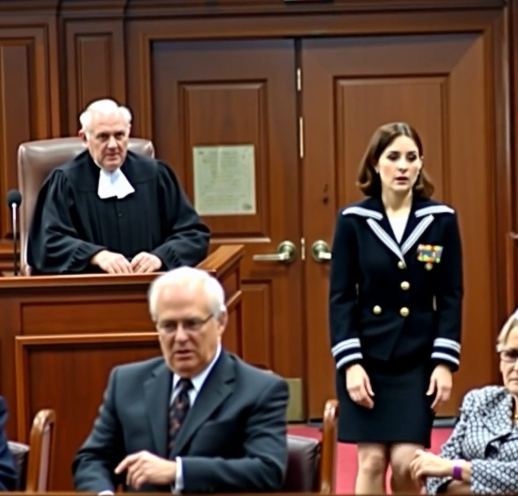
 Looking around the courtroom, I took a deep breath, feeling the weight of the uniform, its fabric heavy with memories and meaning. “Your Honor,” I began, my voice strong despite the lump in my throat. “This house, this home, is more than just property. It’s a legacy. My grandfather’s sweat and dreams built that foundation, and I’ve honored it in my own way.”
I paused, letting my words hang in the air, watching my father’s face harden, a wall built over years of unspoken words. My mother’s eyes, usually so distant, flickered with something I couldn’t place. Regret, maybe? Or disbelief?
“I have always intended to return, to bring life back to that house,” I continued, my gaze steady on the judge. “Circumstances, as you can imagine, Your Honor, took me elsewhere. But I never abandoned it. My service to this country, albeit silent and distant, was always done with the intention of coming back to my roots, to the place that shaped me.”
Judge Simmons nodded slightly, a glimmer of understanding in his eyes. The silence in the room was palpable, only broken by the scratching of a pen as the stenographer recorded each word. I glanced at the spectators, people from my past, their faces a mixture of curiosity and judgment.
“Your Honor, I have paid all necessary taxes and maintained the property as best as I could from afar,” I added, pulling out a stack of documents from my briefcase. “These are the records to prove it.”
The judge took the papers, flipping through them with a keen eye. “Mr. and Mrs. Carter,” he said, turning his gaze to my parents. “Your daughter has served this country with distinction. The court recognizes her sacrifices. Abandonment of property is a serious claim. Do you have evidence beyond the house being unoccupied?”
My father shifted uncomfortably. “We were under the impression that she wasn’t coming back,” he said, his voice softer, almost uncertain. “No communication, no visits. We thought she had moved on.”
I took a deep breath, the familiar scent of the uniform grounding me. “I did move on, Dad. But not from you. Never from you.” My voice was steady, but the emotion beneath it was raw, vulnerable. “I moved on from being the person who couldn’t make you proud. I found pride in myself, in my service.”
The judge looked between us, his expression thoughtful. “This is a family matter,” he said finally, “one that perhaps needs more than just legal intervention.”
As he spoke, I realized that this was more than just a court case. It was a chance to bridge a chasm years in the making. A chance to understand each other beyond expectations and disappointments.
The judge cleared his throat. “I suggest mediation. Let’s find a way for you to communicate, to perhaps find a solution that doesn’t involve litigation.”
The gavel came down with a resonant thud, signaling a temporary end to the proceedings. As people began to file out, I turned to my parents. The courtroom felt suddenly intimate, the three of us standing in a space where so much had been left unsaid.
“Dad, Mom,” I said, my voice softer now, “I want to talk. Not as a soldier, not as someone you’re disappointed in, but as your daughter. Let’s try to understand each other.”
For the first time, my father’s stern facade seemed to crack, and my mother’s eyes softened. Perhaps it was the uniform, or maybe it was just time. Whatever it was, it felt like the start of something new.