Seeing a tiny bug-like object in someone’s hair can be alarming, but it does not automatically mean head lice. Many harmless insects and pieces of debris can become trapped in hair and look surprisingly similar. As the original article explains, “Without a close, magnified visual inspection, it is nearly impossible to definitively identify the object.” Staying calm and checking the details first can prevent unnecessary worry.
Ants, small spiders, mites, fleas, and even bed bug nymphs can sometimes be mistaken for lice. Fleas usually jump and are more commonly found around pets or carpets, while bed bugs generally hide in mattresses, furniture, or clothing rather than living in hair. Often, the mysterious “bug” is not an insect at all—it may simply be lint, a seed, dried hair product, or dust caught between strands.
Movement can provide an important clue. Head lice cannot fly or jump and usually crawl slowly. If the object suddenly jumped, it is more likely to be a flea or another insect. Also, finding only one isolated bug makes lice less likely. Persistent itching can be another clue, although itching alone does not prove an infestation.
Adult head lice are about the size of a sesame seed and have a flat, grayish or tan body. Their eggs, called nits, are even easier to distinguish because they are firmly attached to individual hairs close to the scalp. Unlike dandruff or lint, “a nit will not easily flick, slide, or blow off the hair.”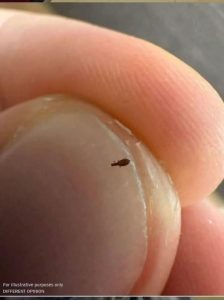
If there is still uncertainty, take a clear, well-lit close-up photograph of the object. A good photo can make identification much easier and help determine whether the discovery is actually lice or simply a harmless visitor.