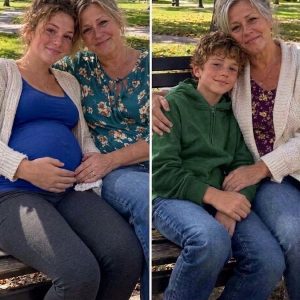
“Consider her dead,” he used to say, his voice flat in a way that made questions feel dangerous, while Mom would go quiet, her lips pressed thin like she’d swallowed something sharp. Growing up, I imagined this forbidden woman as cruel, heartless—someone who must have done something unforgivable to deserve being erased from our lives, so I simply stopped wondering. Years passed and I became a nurse who memorized charts, double-checked IVs, and kept emotional distance from patients to survive the job. But during a routine shift, scanning new admissions brought my heart to a halt when I saw the name I had heard only once by accident as an eight-year-old before my father snapped. My hands trembled as I walked down the hall to her room, telling myself it was a coincidence, until I pushed the door open and saw a woman who looked undeniably like my mother—sharing the same cheekbones and soft gray eyes, though smaller and fragile beneath hospital blankets with silver hair against the pillow.
She smiled gently, saying, “Hello, dear,” in a voice that was far from the villain I had envisioned. I checked her chart while forcing professionalism and asked how she was feeling, to which she admitted she was tired before studying my face and noting that I reminded her of her daughter, whom she hadn’t seen in twenty-five years. The room went very still as I swallowed and asked what happened, prompting her gaze to drift to the window. She explained that her daughter’s husband didn’t like her and claimed she interfered when she spoke up once after seeing him treat her badly. He forced a choice, and her daughter chose her family—a decision she accepted, saying it was what mothers hope for even if it hurts, admitting she eventually stopped sending returned letters and calls because she just wanted her daughter to be safe without causing trouble.
Standing there, I couldn’t breathe as the story I’d grown up with cracked wide open; all those years, I’d believed my father’s version that she was cruel, dangerous, and worth erasing, but the reality was that she had simply been silenced. When I asked for her daughter’s name with a shaking voice, she spoke my mother’s name, confirming the deep connection and shattering decades of deception in an instant. I realized that the villain of my childhood was actually a loving grandmother who had spent a quarter of a century grieving in silence, protecting her daughter from afar while enduring the weight of an unfair exile forced upon her by a controlling man.
I took her frail hand as tears filled her eyes, fragile and bright, and told her that I thought I could help her see her daughter again. When she asked with quiet desperation if I would really do that for her, I nodded and was already reaching for my phone to bridge a gap that had lasted twenty-five years. For the first time in my life, I wasn’t afraid of my father’s rules or his harsh warnings, finally understanding that the truth isn’t always loud or dramatic—sometimes it’s just an old woman in a hospital bed waiting decades for someone to finally open the door.