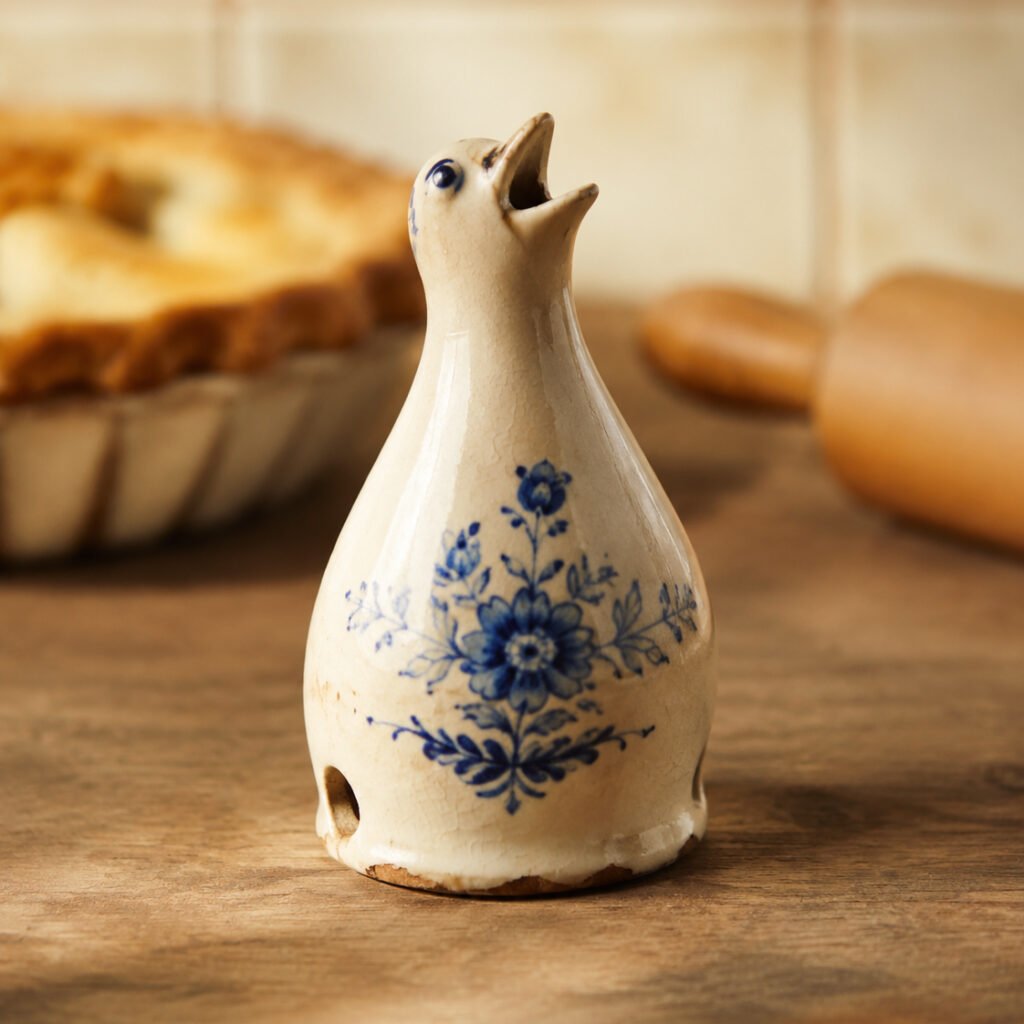
Every Sunday morning, Grandma Rose placed a strange little ceramic bird in the middle of her kitchen table.It was cream-colored, decorated with faded blue flowers, and small enough to fit in one hand. Its glaze was cracked from age, and its beak remained permanently open as though it were waiting to sing.As a child, I assumed it was simply one of Grandma’s decorations. Her kitchen was filled with unusual treasures: painted plates, copper pans and little porcelain animals collected over many years.But this bird was different.Whenever Grandma prepared one of her famous fruit pies, the bird disappeared from the table. A few hours later, it would mysteriously return—warm and covered with traces of berry filling.
I never thought to ask why.Many years later, while helping my mother clear out Grandma’s kitchen, I found the ceramic bird wrapped carefully in an old dish towel.“I remember this,” I said. “Grandma always kept it on the table.”Mom smiled.“It didn’t spend all its time on the table,” she said. “Look at the photographs from our Sunday dinners.”We opened an old family album and found a picture of Grandma holding a freshly baked apple pie. Standing directly in the middle of the golden crust was the little ceramic bird.That was when Mom finally explained the mystery.
The object was known as a pie bird, sometimes called a pie vent or pie funnel. Bakers placed it in the center of a filled pie before covering everything with the upper crust.The bird’s hollow body allowed steam to rise from inside the pie and escape through its open beak. This helped prevent the filling from bubbling over and reduced the chance of the crust becoming soggy.It could also support the upper crust, keeping it from collapsing into the fruit as the pie baked.Pie birds became particularly popular during the 19th and early 20th centuries. Many were shaped like blackbirds, inspired by the nursery rhyme about “four and twenty blackbirds baked in a pie.” Others were produced in different colors and decorated with flowers.
Grandma’s ceramic bird wasn’t valuable because it was rare or expensive. It was valuable because it had stood inside hundreds of pies served at birthdays, holidays and ordinary Sunday dinners.Every small stain and crack carried part of our family history.I carefully washed it and placed it in my own kitchen. Most days it sits on the shelf, where visitors naturally assume it is only a decoration.But whenever I bake Grandma’s apple pie, the little bird returns to work-standing proudly in the center as warm steam escapes through its open beak.After all these years, Grandma’s strange ceramic bird is still helping make Sunday dessert.